
Johns Hopkins UniversityEst. 1876
America’s First Research University
Eileen Perkins remembers holding her father’s hand outside of Mount Vernon, George Washington’s estate in northern Virginia. Perkins was only a toddler. A family photo captured the moment, and she’s smiling — a snapshot of her future passions.
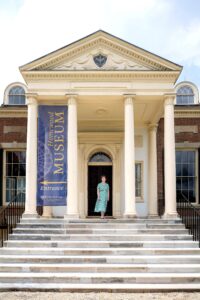
Growing up in Nashville and in a home full of “history buffs,” Perkins became fascinated with early American history and old homes. Those defining moments eventually led her to the Johns Hopkins University Homewood Museum, where Perkins is a docent.
“It’s fulfilling,” says Perkins, A&S ’72 (MLA). “I can indulge in both my love of early American houses and history.”
Homewood is a national historic landmark and was built circa 1801 for members of Maryland’s prominent Carroll family. The house was also home to at least 25 enslaved individuals, including William and Rebecca Ross and their two children and Izadod and Cis Conner and six of their 13 children.
Since 2012, Perkins has experienced three generations of curators — all leaving her inspired. Her dedication to the house and its history is why Perkins included Homewood Museum in her estate plan.
“I’m confident my commitment will continue to expand on the research of daily life at Homewood — of both the enslaved families and Carroll family — while preserving the structure of the home,” she says.
We spoke with Perkins about her giving, Homewood, and reckoning with the past.
It’s the outreach to the community. I’m able to talk about the larger context of what was going on in American history during the early years of the New Republic, and how Baltimore’s economy and its various social classes intersected with the broader picture of American life and consciousness as a nation at that time. Baltimore City, Homewood, and the Carroll family expand on that picture.
I want future generations to have free rein over the gift and apply it where needed. I want to see an expansion of knowledge, insight, and perspectives. Like the framers of the Constitution, we can’t look into the future. I’m contributing to Baltimore’s history and an understanding of it through the lens of the Carroll family, and how the property interacted with the city at large as it existed in the beginning of the 19th century.
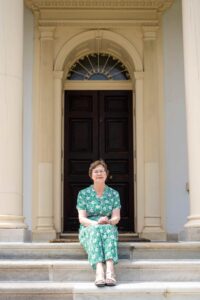
The first question I ask: what is their interest in coming here? The answers vary. Some are interested in the architecture. Others are interested in understanding the lives of the enslaved families, or learning about the dynamics of the Carroll family. I make sure we address those questions.
It’s interesting to explain American life back then and understand how visitors bring their own ideas about the American experiment. On the tour, we discuss how the Carrolls mirrored those ideas in some ways, but were also part of the seriously unfinished business of the Revolution and Constitutional Convention in others, particularly in regard to their treatment of the enslaved families.
We’re still a nation developing our identity and character. We have to study, ask ourselves questions, and research topics from the past with new perspectives and points of views. It gives new insight. Previous generations were looking through a lens that may have had certain prejudices that acted as blinders. Now we can look from a perspective without those blinders. Future generations will look back on our perspectives and say, ‘Look at those blinders being used. Why did they interpret history that way?’ We have to be humble.
Homewood is a living classroom for students, faculty, staff, and the public. Homewood also brings in the academic community to explore the different dynamics of American history, including historic exhibits like this fall’s If Homewood’s Walls Could Talk: A History of an American House.
The back parlor is my favorite, which was in effect the family room. The way the house is situated geographically on the land, its windows face north and west. That room received the last light of the summer evening. In an era when they only had candles and oil lamps for light, in the summer evenings to capture that last evening light and to use that room for their family gathering room, I think is lovely.
This story first appeared in the Fall/Winter 2025 edition of Planning Matters.
Topics: Alumni, Faculty and Staff, Sheridan Libraries and University Museums, Strengthening Partnerships, Support Scholars